


What Event Planners Should Ask Their AV Company Before Signing a Contract
- joyce388
- Mar 25
- 4 min read

The Questions That Protect Your Event and Your Reputation
Choosing an AV partner isn’t just about equipment. It’s about risk management, execution, and trust.
Whether you’re planning a corporate conference, executive summit, product launch, or hybrid event, the AV company you choose will directly influence how your audience experiences your brand.
Before signing a contract, event planners should be asking more than just, “What’s included in the package?”
Here are the critical questions that protect your event and ensure you’re working with a true production partner.
1. What Happens If Equipment Fails?
Technology is reliable until it isn’t.
Microphones can drop signals. Projectors can overheat. Cables can fail. The real question isn’t whether something could go wrong. It’s how quickly it can be corrected.
Ask your AV provider:
Do you carry backup microphones?
Is there redundancy in the audio system?
Are spare cables and adapters on-site?
Is there a backup playback system?
A professional AV team plans for failure before it happens. Redundancy isn’t an upgrade, it’s a safeguard.
If the answer sounds uncertain or “we’ve never had a problem,” that’s a red flag. Experienced production teams assume issues can arise and prepare accordingly.
2. Will There Be On-Site Technicians for the Entire Event?
Some companies drop off equipment. Others stay.
There’s a major difference.
Ask:
Will a technician be present during rehearsals?
Will someone monitor audio levels during the event?
Who manages presenter transitions?
Who handles real-time troubleshooting?
Corporate events move quickly. Speakers change. Videos cue. Lighting shifts. Without a trained technician monitoring the system, even minor issues can snowball.
An on-site AV team allows your internal staff to focus on guests, content, and logistics not sound boards and cables.
3. Have You Worked in This Venue Before?
Every venue is different.
Ballrooms, industrial spaces, outdoor patios, conference centers, each presents unique challenges in:
Acoustics
Ceiling height
Rigging options
Power distribution
Load-in access
Ambient lighting
Ask whether your AV company has worked in the space before. If not, ask whether they conduct pre-event walkthroughs.
Professional AV planning includes site inspections. This allows teams to:
Calculate proper speaker coverage
Plan cable runs
Assess power loads
Identify potential problem areas before event day
A confident “yes, we’ve mapped this space” is worth its weight in gold.
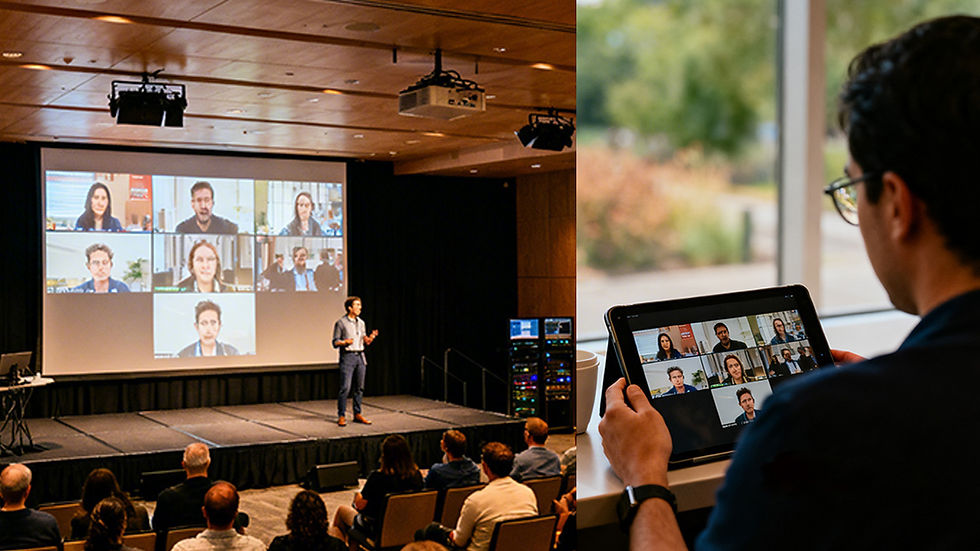
4. How Do You Handle Hybrid and Livestream Bandwidth?
If your event includes a virtual component, internet stability becomes mission-critical.
Ask:
Do you test venue bandwidth?
Do you recommend dedicated lines?
Do you bring backup connectivity solutions?
What encoding platform do you use?
Livestream quality depends on more than cameras. It requires bitrate management, audio optimization, and real-time monitoring.
A reliable AV partner will evaluate connectivity long before guests log in.
5. What Is Included in Pre-Production Planning?
Professional AV doesn’t begin on event day. It begins weeks in advance.
Ask:
Do you provide pre-event consultations?
Will you review run-of-show timelines?
Do you coordinate with speakers regarding slide formats?
Will you attend production meetings?
A well-organized AV partner integrates into your planning process.
This minimizes surprises, improves transitions, and ensures every cue aligns with your program flow.
6. What Insurance and Liability Coverage Do You Carry?
This question often gets overlooked, but it matters.
Professional AV companies carry insurance for:
Equipment
Liability
Venue compliance
Venues frequently require certificates of insurance before allowing load-in.
An established production partner will have documentation ready and understand venue compliance requirements.
7. How Is Labor Structured?
Labor transparency is important.
Ask:
How many technicians will be onsite?
What are the setup and strike times?
Are overtime rates clearly defined?
Is rehearsal time included?
Clear labor structure prevents billing surprises and ensures adequate staffing levels.
Understaffed events often lead to rushed setup and reactive troubleshooting.
8. Can You Scale If Our Event Grows?
Corporate events evolve. Agendas expand. Guest counts increase. Hybrid needs develop.
Ask whether your AV partner can scale:
Larger LED walls
Additional breakout rooms
Expanded audio coverage
Multi-camera production
A scalable partner gives you flexibility without needing to start from scratch.
9. What Is Your Communication Process?
Clear communication reduces stress.
Ask:
Who is your primary point of contact?
How quickly do you respond to change requests?
Is there a dedicated project manager?
Event planners need responsiveness. A reliable AV company operates with structured communication, not last-minute scrambling.
10. What Makes You Different from a Rental Company?
This may be the most important question.
There is a difference between:
A company that rents equipment
And a company that produces events
A production partner provides:
Strategic recommendations
Technical expertise
Redundancy planning
On-site support
Post-event coordination
The equipment matters, but the experience matters more.
The Bottom Line: You’re Not Just Renting Equipment
You’re protecting:
Your company’s reputation
Your executive team’s presentation
Your audience’s experience
Your own peace of mind
The right AV partner makes your event feel seamless, not stressful.
Before signing your next contract, ask these questions. The answers will tell you whether you’re hiring a vendor… or gaining a partner.
If you’re planning an upcoming corporate event and want to walk through these considerations with an experienced team, Corporate AV is always available for a conversation. No pressure, just practical guidance to ensure your event delivers exactly what it should.


Comments