

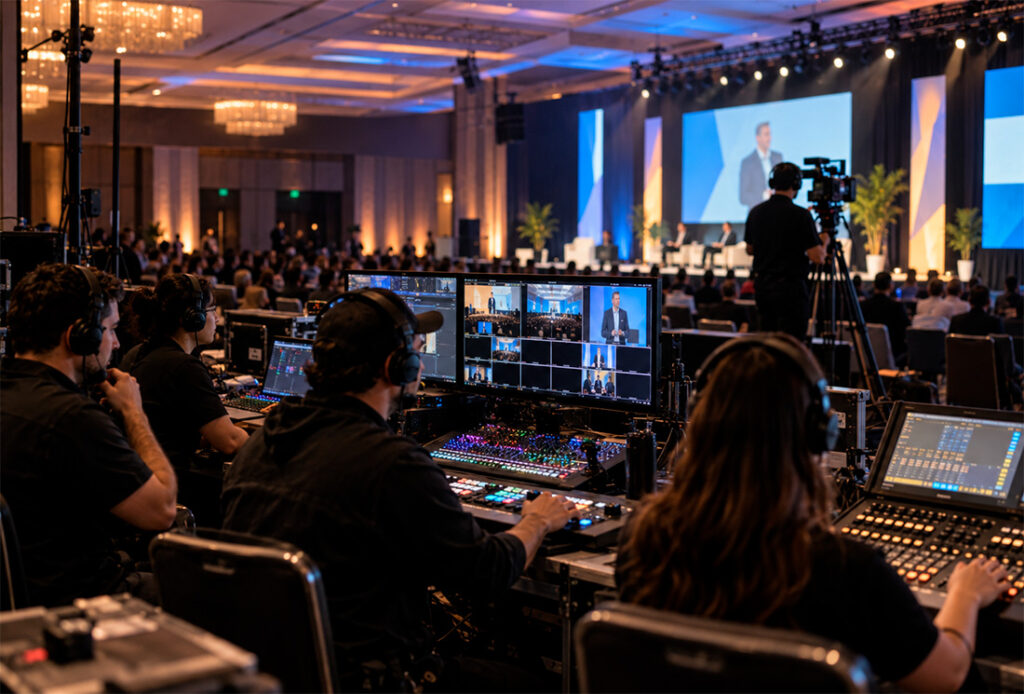
Corporate events rarely rely on one piece of technology. A keynote may need wireless microphones, presentation screens, stage lighting, cameras, confidence monitors, video playback, recording, and a livestream running at the same time. Add multiple speakers, remote presenters, audience questions, and last-minute presentation changes, and the technical side of an event can quickly become complicated.
One way to make it easier is to work with a production team that can manage audio, video, lighting, and livestreaming together.
That does not simply reduce the number of vendors involved. It can also improve communication, simplify planning, and help the different technical systems work together as one production.
The Different Parts of an Event Are Connected
Audio, video, lighting, and livestreaming may sound like separate services, but during a live event they constantly interact.
A camera shot depends on lighting.
A livestream depends on clean audio.
A presentation shown on the ballroom screens may also need to appear correctly in the livestream.
A remote speaker may need to hear the room, see the presentation, and be displayed onstage without introducing feedback or delay.
When different companies handle each part of the production, those connections still have to be managed. Someone needs to determine how the systems will communicate and who is responsible when one part affects another.
With an integrated production team, those conversations can happen within the same crew before the event begins.
Fewer Vendors Means Fewer Communication Gaps
Anyone who has planned a corporate event knows how quickly email chains can multiply.
The venue is talking to the audio company. The video company needs information from the livestream provider. The lighting crew needs the stage dimensions. The keynote speaker has a new presentation. Marketing wants to know whether a video can play in the room and on the webcast.
Now imagine coordinating those questions across several vendors.
Working with one production team gives event planners a central point of communication for the technical production.
Instead of figuring out which vendor handles a particular issue, the planner can communicate the need and let the production team coordinate the technical details internally.
That becomes particularly useful when plans change, which they almost always do.
One Production Plan Can Improve Consistency
An integrated production team can look at the event as a whole rather than treating each technical service as an independent assignment.
For example, lighting can be designed with both the live audience and the cameras in mind. A presentation system can be configured so slides display correctly in the ballroom, on confidence monitors, and in the livestream. Microphones can feed the house sound system while also providing clean audio for recording and remote viewers.
Those decisions are easier to make when the same production team understands how the entire system is being used.
The result is not necessarily more equipment.
Often, it is simply better coordination of the equipment already required.
Troubleshooting Is Faster When Everyone Knows the System
Live events move quickly.
If a presenter’s microphone stops working five minutes before a keynote, there is not much time for a committee meeting.
The same is true when a remote presenter cannot hear the room, a video file will not play correctly, or the livestream is receiving the wrong audio feed.
When several independent vendors are involved, troubleshooting can sometimes begin with a familiar question:
“Whose system is causing the problem?”
An integrated crew can focus on solving it instead.
Because the production team understands how the audio, video, lighting, camera, and streaming systems are connected, technicians can often identify the source of a problem more quickly.
That does not mean technical issues never happen. They do.
The difference is having a team that can respond without first determining which vendor owns which piece of the puzzle.
Livestreaming Becomes Part of the Event Instead of a Separate Production
Livestreaming is one area where integrated planning makes a noticeable difference.
A webcast is not simply a camera pointed at the stage.
Remote viewers need to hear speakers clearly, see presentation content, follow panel discussions, and understand what is happening in the room.
That means the livestream relies on many of the same systems being used for the live audience.
Audio feeds must be clean. Cameras need appropriate lighting. Presentation graphics need to be routed properly. Videos need to play correctly both in the room and online.
If the livestream is planned separately at the end of the process, compromises may be necessary.
When streaming is considered from the beginning, the production can be designed for both audiences at the same time.
Your Event Team Has Fewer Moving Parts to Manage
Technical production is only one part of organizing a corporate event.
Event planners are also coordinating speakers, schedules, catering, venues, guests, transportation, branding, presentations, and countless other details.
Managing four or five separate technical vendors creates another layer of work.
Working with one production partner can reduce that administrative burden.
There may be one production schedule, one technical planning process, and one team responsible for coordinating the equipment and crew.
For a busy event manager, fewer moving parts can make a significant difference.
Integrated Production Can Help With Last-Minute Changes
Corporate events can change even after everyone agrees the schedule is final.
A speaker brings a new laptop.
A panelist joins remotely.
The CEO wants to add a video.
A presentation arrives five minutes before showtime.
A meeting that was originally intended to be in-person suddenly needs to be streamed to another office.
These situations are easier to address when the production team understands the complete technical setup.
Instead of coordinating changes across several companies, the production crew can determine how the change affects sound, screens, cameras, lighting, recording, and streaming.
That flexibility can be especially useful for conferences, executive meetings, product launches, town halls, and other events where the program continues evolving right up to showtime.
One Team Does Not Mean One-Size-Fits-All
Integrated production support does not mean every event needs a massive technical setup.
A 75-person leadership meeting may require a very different system from a multi-day customer conference.
The advantage of working with one team is that the production can be designed around the event rather than around separate vendor responsibilities.
Some events may need sophisticated lighting and multiple cameras. Others may need excellent audio, clean presentations, and a reliable livestream.
The important part is that the technology works together.
The Audience Should Notice the Event, Not the Technology
When event production works properly, most attendees never think about the coordination happening behind the scenes.
They hear the speaker clearly.
They see the presentation.
The stage looks good.
Remote attendees can follow along.
Videos play when they are supposed to.
That is the point.
Audio, video, lighting, and livestreaming are different disciplines, but during a corporate event, they all support the same experience.
Bringing them together under one production team can simplify planning and help the event run more smoothly, from the first presentation to the final sign-off.
Planning a Corporate Event?
Corporate AV provides integrated audio, video, lighting, livestreaming, recording, and event production support for corporate meetings and events throughout the Bay Area and California.
If you are planning a conference, town hall, product launch, company meeting, or hybrid event, contact Corporate AV to discuss the technical production and build a system that works together from the start.