

Finding the right venue can feel like one of the biggest wins in event planning. The room looks great, the location works, the date is available, and everyone can finally start picturing the event coming together.
Then the AV team walks in.
Suddenly, questions come up about electrical circuits, ceiling heights, Wi-Fi bandwidth, reflective walls, loading access, and whether that beautiful wall of windows will turn your presentation screen into a mirror at 3:00 in the afternoon.
None of this means you chose the wrong venue. It means every space has its own technical personality.
For event planners, understanding a few common venue challenges can make planning easier, prevent last-minute surprises, and help your AV team build a production plan around the room you actually have.
Lighting: The Room May Have Its Own Ideas
Natural light is a great selling point when touring a venue. It can be less appealing when you are trying to project a presentation onto a screen.
Large windows, skylights, reflective surfaces, low ceilings, and existing architectural lighting can all affect how an event looks in person and on camera.
A daytime ballroom with floor-to-ceiling windows, for example, may need additional lighting control to keep screens visible. A darker industrial venue might require more production lighting than expected simply to make speakers and guests look good.
Lighting also needs to work for more than the people sitting in the room. If you are recording or livestreaming the event, cameras may need considerably more controlled lighting than the audience does.
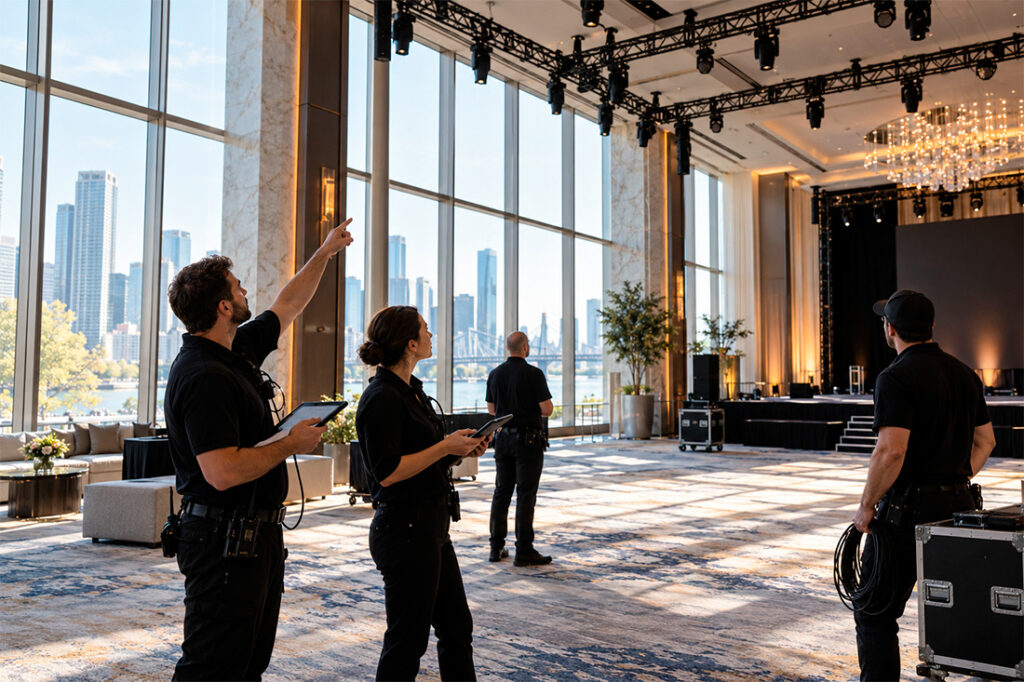
This is one reason an AV walkthrough before the event can be so useful. Your production team can see where natural light enters the room, determine where presenters will stand, evaluate existing fixtures, and plan additional lighting before equipment arrives.
The goal is not always to add more light. Sometimes it is about controlling the light that is already there.
Sound: A Beautiful Room Can Still Sound Terrible
You cannot tell how a room sounds from a photograph.
High ceilings, concrete floors, glass walls, exposed beams, and large open spaces may look fantastic but create echoes and reverberation that make speech difficult to understand.
Even traditional hotel ballrooms have their quirks. Divisible walls, unusual room shapes, adjacent events, HVAC systems, and audience size can all affect sound.
The solution is rarely as simple as turning up the speakers.
A good audio plan considers where the audience will sit, where presenters will speak, how sound travels through the room, and where speakers should be positioned to provide even coverage.
Microphone selection matters too. A panel discussion has different requirements from a keynote presentation. A handheld microphone behaves differently from a lavalier. If audience Q&A is part of the program, plan for that as well.
The best time to discover an acoustic problem is during a site visit or sound check, not when the CEO walks onto the stage.
Power: The Outlet Is Only the Beginning
It is easy to look around a venue, see plenty of electrical outlets, and assume power is covered.
Unfortunately, outlets do not tell the whole story.
Lighting systems, video displays, LED walls, projectors, audio equipment, cameras, computers, livestreaming equipment, and staging technology can place significant demands on a venue’s electrical system. Several outlets may even share the same circuit.
That means your production team needs to know not only where power is available, but how much power is available and how it is distributed throughout the space.
This is especially important in older buildings, warehouses, outdoor venues, temporary event spaces, and locations never designed specifically for live production.
Power planning also affects cable runs and equipment placement. If the right electrical connection is on the opposite side of the room from where equipment needs to go, the AV plan has to account for that safely.
These small floor-plan details can become major issues on event day.
Internet: “We Have Wi-Fi” Is Not a Technical Specification
For a basic in-person meeting, venue Wi-Fi may be perfectly adequate.
For a livestream, hybrid event, remote presenter, cloud-based presentation, or interactive audience platform, “we have Wi-Fi” is the beginning of the conversation, not the end.
Your AV team needs to understand what kind of connection is available, how much bandwidth can be dedicated to the event, whether a wired connection is possible, and how many other people or events may be sharing the network.
A hotel network that works perfectly during an empty-room test may behave very differently once hundreds of attendees arrive and connect their phones and laptops.
Whenever internet connectivity is part of the production, testing should happen well before the program begins. For livestreaming in particular, a wired connection is generally preferable to relying entirely on public or shared Wi-Fi. Corporate AV makes this same recommendation in its livestream planning guidance.
Depending on the event, your production team may also recommend backup connectivity so one network issue does not bring the online portion of the event to a stop.
The Venue Walkthrough Is Where Problems Become Plans
One of the most useful things an event planner can do is bring the AV team into the conversation early.
A site visit gives technicians a chance to look at the same room through a very different lens.
They check sightlines and listen to the room. They look for power, measure distances, and identify possible cable paths. They check internet access, study loading areas and elevators, and look at ceilings and rigging points.
They also consider something easy to overlook: how everything gets into the building in the first place.
A ballroom on the second floor with one small service elevator may require a very different setup schedule than a ground-floor event space with direct loading access.
Corporate AV’s venue-planning guidance emphasizes these walkthroughs because floor plans alone often don’t reveal issues involving power, acoustics, connectivity, cable routing, loading access, or audience sightlines.
Ask the Questions Before Event Day
Event planners do not need to become lighting designers, audio engineers, electricians, or network technicians.
You need to know when to bring those people into the conversation.
Before finalizing the production plan, make sure your venue and AV partner have discussed lighting conditions, room acoustics, available electrical service, internet connectivity, load-in requirements, equipment placement, and any restrictions the venue places on outside production teams.
The earlier those conversations happen, the more options you have.
A venue challenge discovered three weeks before an event is usually a planning problem. The same challenge discovered three minutes before doors open is an emergency.
Every Space Can Work Differently
No event venue is universally perfect.
A hotel ballroom may offer excellent infrastructure but limited creative flexibility. A warehouse may offer incredible visual possibilities while requiring additional power, lighting, and acoustic planning. A rooftop can provide an unforgettable backdrop while also introducing wind, noise, access, and connectivity issues.
The production team’s job is not to fight the venue. It is to understand it and design around it.
At Corporate AV, LLC, we work with event planners to evaluate the space, identify potential technical challenges, and build the audio, video, lighting, and production plan around the venue’s realities. From corporate meetings and conferences to hybrid and livestreamed events, planning gives everyone more time to focus on what the audience actually came to experience.
Planning an upcoming event? Contact Corporate AV to talk through your venue and production needs before event day.