

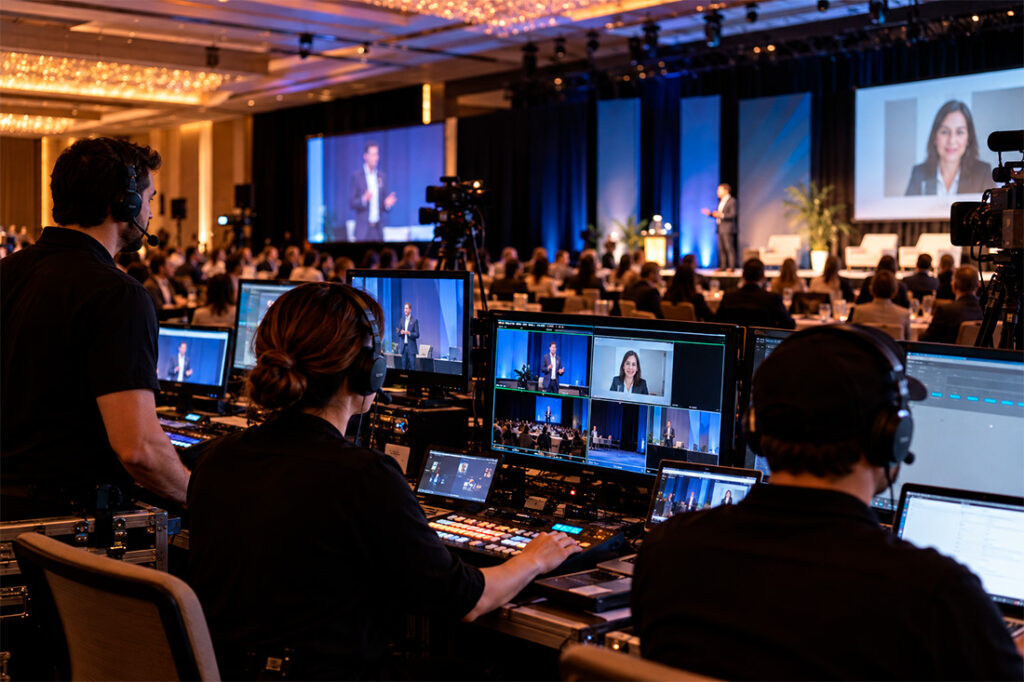
There was a time when event production could be planned around a fairly fixed set of assumptions.
The guest count was confirmed. Speakers were expected to be in the room. The agenda was finalized weeks in advance. A presentation happened live, the audience watched it, and once the event ended, the production was essentially finished.
That is increasingly not how corporate events work.
Attendance can change. A speaker may suddenly need to join remotely. An in-person meeting can develop a virtual component. A session planned for 200 people may end up with 120 attendees, or 300. Leadership may decide to record a keynote. You can add a presentation to the agenda the day before the event.
For event planners and production teams, flexibility is becoming part of the basic production plan. The goal is not to prepare for every possible scenario. It is to build an event that can absorb reasonable changes without forcing the entire production to be redesigned.
Attendance Numbers Are Less Predictable
One of the clearest reasons flexibility matters is attendance.
Registration numbers do not always translate directly into the number of people who walk through the door. Corporate travel plans change. Internal meetings shift. Weather affects transportation. Some attendees decide to participate remotely. Others register at the last minute.
If the production plan is built around a single attendance number, even a moderate change can create problems.
A larger audience may require additional screens so people in the back can see presentations clearly. Audio coverage may need to extend farther. You may need additional microphones for audience participation.
A smaller turnout creates a different challenge. A room designed for 500 people can feel empty with 200 guests, even if the content itself is excellent.
Flexible production planning considers how the event can scale. Screens, seating areas, speaker placement, lighting zones, and room layouts can often be planned to let the space expand or contract without making the change obvious to the audience.
That is a much better position to be in than trying to solve the problem after attendees begin arriving.
Speakers Are Not Always Where You Expected Them to Be
Remote participation has also changed expectations.
A speaker who cannot travel no longer necessarily means removing that person from the agenda. They may be able to participate through a remote video connection.
But that only works smoothly when the production has been designed to accommodate it.
Adding a remote presenter involves more than opening a video meeting on a laptop. The remote speaker needs to hear the room clearly. The audience needs to see and hear the speaker. Presentations may need to be shared between locations. Someone needs to manage the connection, monitor audio, and communicate with the presenter before they go live.
If none of that infrastructure exists, what seems like a simple change can quickly become a complicated production problem.
Building some remote capability into the event from the beginning gives planners more options when schedules change.
Event Formats Can Change Too
Sometimes the change is larger than one speaker.
An organization may initially plan an entirely in-person meeting and later decide that employees in other offices should be able to watch. A conference may add a livestream after registration exceeds the venue’s capacity. A leadership presentation might suddenly need to reach employees who could not attend.
Without a flexible production plan, these decisions can require new equipment, additional crew, different internet requirements, revised staging, and changes to the run of show.
With the right preparation, the transition can be much easier.
Cameras may already be positioned with streaming in mind. Audio systems can be configured to send a clean feed to both the room and an online audience. A central system can manage presentation files. You can test internet connectivity for a possible broadcast even if streaming isn’t part of the original plan.
Not every event needs to be produced as a hybrid event from day one. The point is to understand which elements would be difficult to add later and plan accordingly.
A Changing Agenda Should Not Create Production Chaos
Anyone who has produced a corporate event knows that agendas have a habit of changing.
A 30-minute presentation becomes 45 minutes. A panel discussion is added. The CEO wants to show a video. One speaker now needs slides. Another decides not to use them. An awards presentation is added to the schedule.
The production team needs to respond without disrupting the flow of the event.
That becomes much easier when audio, video, lighting, and presentation systems are designed as one coordinated production rather than isolated pieces of equipment.
A flexible show file, organized presentation management, programmable lighting, appropriately selected microphones, and clear communication between the planner and technical crew all make adjustments easier.
The audience should rarely know anything changed.
Flexibility Can Protect the Budget
Building flexibility into an event might seem like it automatically increases production costs. In many cases, the opposite can be true.
The expensive situation is often discovering late that the original plan no longer works.
Rush equipment orders, additional technicians, overnight deliveries, last-minute internet upgrades, or completely reconfiguring a room can cost considerably more than planning a modest amount of flexibility from the beginning.
Scalable systems also allow production resources to match what the event actually needs.
For example, a planner may know that attendance could range from 150 to 250 people. Rather than committing immediately to a production designed for the maximum, the AV team can build a system that can expand if registration reaches a certain threshold.
That gives the planner a clearer way to manage both expectations and budget.
Recording Creates Another Kind of Flexibility
An event no longer has to exist only in the moment.
Recording selected sessions can give organizations options they may not even know they need yet.
A keynote can later become an internal training resource. Short clips can be used for social media. A panel discussion can become part of an employee communication campaign. You can share a presentation with people who couldn’t attend.
This is another area where planning matters.
Suppose you add recording as an afterthought; camera positions, lighting, audio feeds, and presentation graphics may not be designed for it. The event may look great to the live audience but produce a disappointing recording.
Planning for possible content reuse gives the organization more options after the event.
The Cost of a Rigid Production Plan
Without flexibility, small changes can trigger a chain reaction.
A larger audience changes the room layout. The new layout changes screen placement. That affects sightlines. Moving the screens changes cable runs. Additional seating requires more audio coverage. Suddenly, one attendance adjustment has affected four different parts of the production.
The same thing can happen when adding a remote speaker, livestream, recording requirement, or new presentation.
Rigid production plans leave very little room for those changes.
They also create stress for everyone involved. Event planners have fewer options. Production teams have less time to solve problems. Vendors may need to source equipment quickly. Clients may face unexpected costs.
Flexibility gives everyone more room to make good decisions.
Flexibility Starts With Communication
Flexible event production does not mean keeping every decision open until the last minute.
In fact, it requires the opposite.
The more the production team understands about the event early in the process, the easier it is to spot where flexibility might help.
Could attendance increase significantly? Might remote speakers be added? Could the event be streamed? Could sessions be recorded? Are agenda changes likely? Will the organization want content from the event afterward?
Those conversations let an AV partner design systems that adapt where needed while keeping the rest of the production simple.
Build for the Event You Have, With Room for the Event You Might Have
Event production will always involve changes. The difference is whether those changes become manageable adjustments or last-minute emergencies.
A flexible production plan gives event planners more options when attendance shifts, speakers change, formats evolve, or new goals appear.
It does not mean overproducing an event or preparing expensive backup plans for every imaginable situation. It means identifying the areas most likely to change and making sure the production can respond.
At Corporate AV, LLC, we work with event planners to build audio, video, lighting, livestreaming, and production systems around both the planned event and the realities that can change along the way.
Planning an upcoming corporate event? Talk with Corporate AV about building a production plan that can adapt when the event does.